
STIMULATING LASERS
BIOLASER 1 & BIOLASER 2

BIOLASER devices are modern medical biostimulation lasers, operating in infrared and red light. These devices are available for wide group of users because of low price, ease operation and high effectiveness. BIOLASERs cover wide area of applications thanks to different, selectable frequencies of modulation. During development we have laid special stress on ergonomic use. BIOLASERs have features like extended sound and optical signaling, rechargeable supply, battery charger and optical power meter. All these make use of BIOLASER a pleasure. The device is equipped with a smart detector of acupunctural points, which is very useful for non-advanced users. It does not require any regulation. The detector 'learns' the skin and this way correctly locates the points.
Main applications of BIOLASERs:
-
acupuncture:
correction of organ and tissue activity, rheumatology, nerve system diseases, analgesic and anti-inflammatory action.
-
dermatology:
ulceration, bedsore removal, burn, open wound healing, herpes removal.
-
cosmetics:
wrinkles and edema removal, acne removal.
BIOLASER devices are used in:
-
hospitals
-
physician offices
-
analgesic clinics
-
dentist's offices
-
biological renewal rooms
-
sport clubs
-
sanatoriums
-
cosmetic and beauty rooms
The following information is presented on the display:
-
work program
-
laser light energy delivered
-
stimulation time
-
acupunctural points detector level
-
battery state
Technical data about BIOLASER 1 and BIOLASER 2 devices:
The lasers are made in microprocessor technology, all of their parameters are set with high precision and stability.
BIOLASER 1
Laser light power: 5 mW and 50 mW
Wavelength: 790 nm or 808 nm
(infrared)
Beam divergence angle: 9° - 30° (ellipse)
BIOLASER 2
Laser light power: 5 mW and 50 mW
Wavelength: 635 nm or 660 nm
(red)
Beam divergence angle: 9° - 30° (ellipse)
Emission modes:
Basic applications:
Constant emission
Restoring energetic organism balance, treatment of wounds, skin diseases, cosmetics.
10 Hz modulation
Organism strengthening, central nervous system diseases.
2500 Hz modulation
Analgesia in chronic pain.
8500 Hz modulation
Antiphlogistic activity and analgesia in sharp pain.
Size: length height depth
18 cm x 2.3 cm x 3.5 cm (7 1/16" x 7/8" x 1 3/8")
Supply:
Li-Ion rechargeable battery 700mAh
Mass (approx.):
100g (3.53 ounces)
BIOLASER 1 and BIOLASER 2 stimulation lasers are both constructed according to identical design assumptions. Technically, the only element which differs in the two devices is the active element, i.e. the laser diode.
BIOLASER 1 emits infrared radiation at wavelength 790nm or 808 nm, while BIOLASER 2 emits red light at wavelength 635nm.
Light wavelength has a huge therapeutical meaning. Infrared easily penetrates the skin, while red light is better absorbed by the skin. The graph below displays the absorption of the laser light by biological tissue:

BIOLASER 2 emits red light, which less easily penetrates the skin, therefore the device is suitable rather for surface treatment - the whole energy is absorbed by outer layers of the skin. The infrared laser BIOLASER 1 emits radiation which penetrates the skin more easily, therefore performs better in treating inflammations, aches of bones and joints, etc. Both devices have similar applications, but there is a shift of efficiency maximum - red is approx. 30% more efficient when treating surface, infrared is approx. 30% more efficient in treating the deeper layers.
KOLMIO RYODORAKU
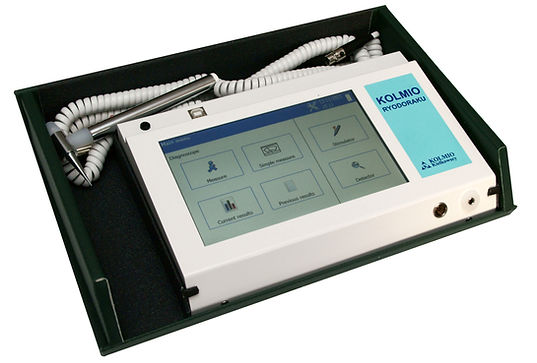
KOLMIO RYODORAKU is a set of three devices in one:
• diagnoscope - when applying the Ryodoraku method, it allows to accurately determine the bioelectric activity of the body and perform an early diagnosis.
• stimulator - it allows performing a biostimulation appropriate for the patient's condition, accordingly to the Ryodoraku therapy principles.
• point detector - it allows less experienced patients to accurately locate the points of acupuncture.

The Ryodoraku method is known for 50 years; it was developed in Japan by prof. Yoshio Nakatani. It is known in Poland since 1983 - the devices' prototypes have been developed in the Biocybernetics and Biomedical Engineering Institute of the Polish Academy of Sciences in Warsaw, with advice from prof. Zbigniew Garnuszewski.
The KOLMIO RYODORAKU device is based on one of these devices, developed by Eng. Waldemar Jarosiński. It was designed with the use of most modern technologies, based on microprocessor technology. The design was made with emphasis on the ergonomy of usage:
-
On one hand, the necessity for measurement and control activity was greatly minimized, allowing reduction of the time required for diagnosing,
-
On the other hand, the device does not impose any value on the doctor but only suggests the parameter defaults.
-
The device can be connected to the computer and send there the results of the examinations. The BM Ryodoraku mini program is supplied with the device and is used to manage the database of patients and examinations and to print the Ryodoraku form.
The small dimensions of the device, battery power supply, result memory, digital and graphical result presentation, modern solutions make applying the Ryodoraku method possible and easy not only in the doctor's office, but also at the patient's home.
Basic applications of the KOLMIO RYODORAKU device:
-
diagnosis:
a quick and easy diagnosis of the patient's general condition,
a detailed diagnosis using tables of symptoms,
a great starting point for making a full diagnosis by a physician. -
stimulation:
instant improvement of the patient's general condition,
stimulation specific for particular ailments. -
point detection:
an excellent, automatic point detector, adjustable to any kind of skin. -
control:
reliable verification of any therapeutic actions, as well conventional as unconventional - just diagnose the patient using the Ryodoraku method before and after the therapy.
TECHNICAL INFORMATION
The KOLMIO RYODORAKU device is designed using microprocessor technology, which allows achieving high precision and stable values of all technical parameters. The information is displayed on a large color display; the device is operated by the touch panel and the encoder.
Basic information:
Working modes:
-
Diagnoscope
-
measure with 6 V, 12 V or 21 V voltage.
-
measure in automatic or manual mode.
-
-
Stimulator
-
current amplitude 0 - 1000 µA.
-
negative, positive or bipolar polarization.
-
constant current, rectangle, triangle, saw or sine shape.
-
frequency 1 - 100 Hz.
-
-
3. Point detector
-
automatic or manual sensitivity regulation.
-
the skin conductance indicator.
-
Display: Color 7", touch panel
Equipment:
1. Active electrode
2. Passive electrode
3. Containers for cotton and normal saline
4. Case
5. Battery recharger
6. Literature:
User's manual,
Ryodoraku method description,
The book "Your health in your hands"
Power supply:
Li-Ion rechargeable battery 3000mAh
Dimensions:
24 x 16 x 4 cm
9 1/2" x 6 1/4" x 1 5/8"
Dimensions when in case:
31 x 21 x 5 cm
12 1/4" x 8 1/4" x 2"
The Ryodoraku Method
The Ryodoraku method has been known for 50 years; it was developed in Japan by Prof. Yoshio Nakatani. In Poland, it has been in use since 1983. Its pioneers were physicians from the Acupunctural Treatment Consulting Unit (presently the Z. Garnuszewski Center of Acupuncture).
RYODORAKU means "line of high electrical conductivity." This is what the method's creator called the lines he discovered, which virtually overlap with the meridians of classical acupuncture.
Since 1950, in Osaka, Japan, Prof. Y. Nakatani had been leading research aimed at finding the relationship between the functional state of internal organs and the electrical resistance measured at points corresponding to the meridians. During the measurement of electrical conductivity (the reciprocal of electrical resistance) in patients suffering from kidney inflammation, points of increased conductivity (compared to their surroundings) were found. These points were named Reactive Electro-Permeable Points, or REPPs. Research conducted on a large number of patients and healthy individuals showed that REPPs could be found in 9 out of 10 people with kidney ailments but were never found in healthy people. It turned out that these REPPs lay on a single line that overlapped with the kidney meridian points. Nakatani named it the Kidney Ryodoraku.
Further research revealed the existence of another REPP line, which overlaps with the classical lung meridian and accompanies lung ailments. It was also found that the Ryodoraku line corresponding to the large intestine sometimes appears in patients with lung illnesses, which supports the theory that a front-back, or yin-yang, relationship between meridians exists.
As a result, 12 pairs of Ryodoraku lines (which accurately, though not perfectly, overlap with classical acupuncture meridians) were identified. Additionally, a couple hundred REPPs were described.
The measurement of electrical conductivity in all REPPs is impossible and cannot be applied in practice. Therefore, Nakatani aimed to utilize measurements taken at specific REPPs for the objectivization of deviations found on each of the Ryodoraku lines. He assumed that a pathological Ryodoraku would show either significantly increased or decreased electrical conductivity compared to that of a physiological Ryodoraku. To confirm this, the average values of electrical conductivity at all REPPs along a specific meridian had to be found.
Further research refuted the need to take measurements at all REPPs. It is sufficient to measure them only at Representative Measuring Points, or RMPs. These points share the following feature: their average electrical conductivity is equal to the average conductivities of the REPPs along the entire meridian.
The Ryodoraku diagnostic process begins with the measurement of electrical conductivities at 24 RMPs. Then, the results are plotted on a special form: the Ryodoraku analysis card.

Deviations from the average (the so-called physiological tunnel) of the Ryodoraku lines can be easily read from the analysis table. The basis for making a diagnosis is the following information:
-
values of deviations of individual results,
-
direction of the deviation (above or below the physiological tunnel),
-
relationship between individual results,
-
differences between the left and right sides of the body.
Making a general diagnosis on the basis of the table alone is only the beginning. Then, a detailed diagnosis should be made on the basis of the Ryodoraku symptom table.
After diagnosing, a stimulation may be performed; we distinguish between two treatment methods:
-
autonomic nervous system's general regulation therapy,
-
autonomic nervous system's local regulation.
Each of the therapies may be performed in two ways — either through a stuck acupuncture needle (by touching it with the active electrode) or directly (by touching the skin with the active electrode).
General Ryodoraku therapy is applied in cases of chronic diseases, when it is necessary to activate the whole organism.
After performing Ryodoraku measurements and filling in the Ryodoraku table with the results, channels with energetic excess and deficiency are specified. At first, the two Ryodoraku that are most deviant from the physiological tunnel should be chosen and the stimulation should be performed on these; later, the number of stimulated points can be increased, up to all those that are outside the physiological tunnel. It should be noted, however, that with the progress of the therapy, the number of deviant Ryodoraku decreases!
REPP local therapy brings rapid help in cases of acute illnesses; it can also be treated as one of the stages of local treatment. The therapy consists of two stages:
-
Locating REPPs on a given Ryodoraku.
-
Stimulation of the located REPPs.
The principle of this therapy is that REPPs which show increased electric conductivity are connected with the patient's ailment.
The description above is only an outline of the method. Appropriate literature should be consulted for detailed information, e.g., "The Ryodoraku Method" study supplied with the KOLMIO RYODORAKU device.
